

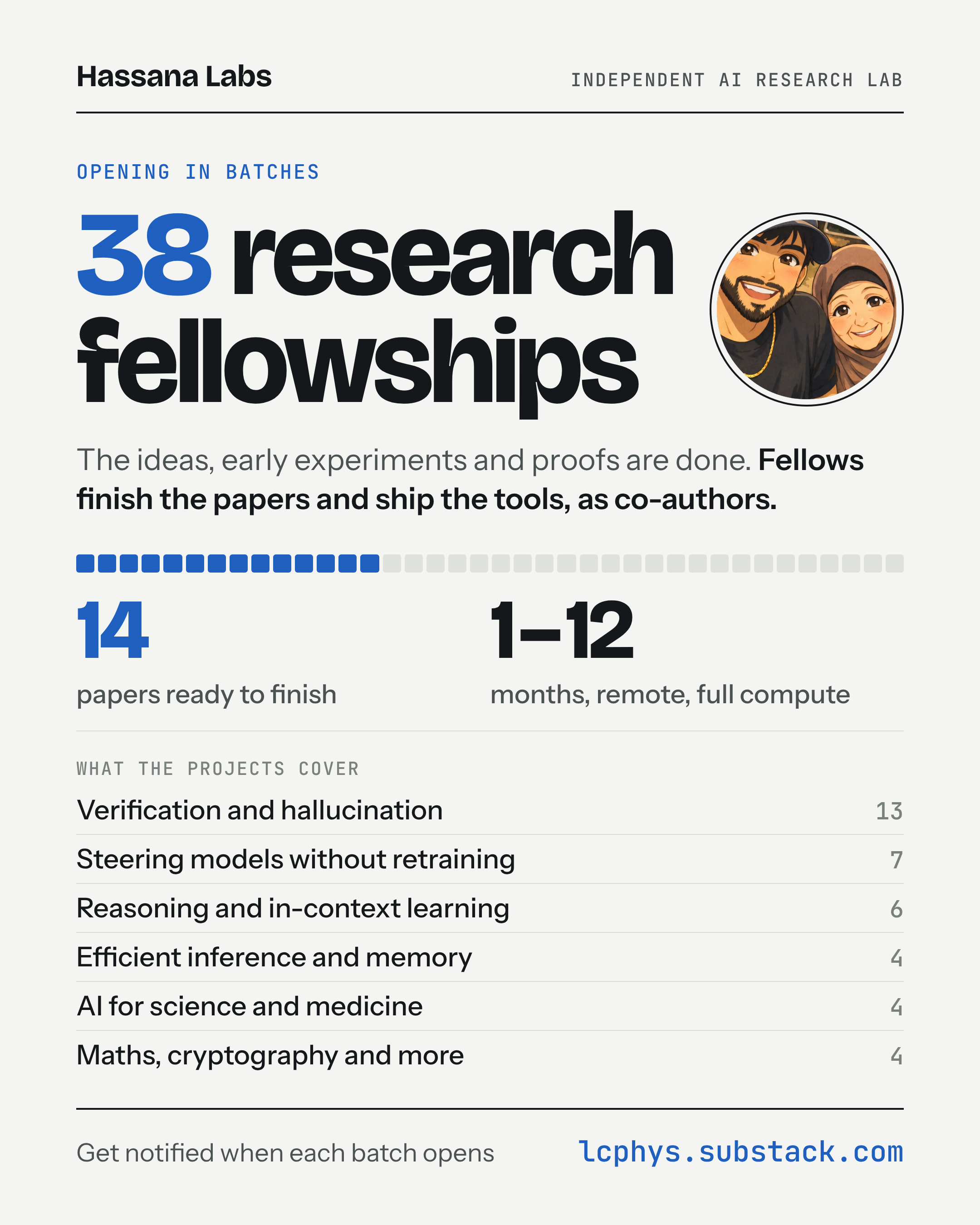
BIG BIG announcement: Hassana Labs is excited to announce 38 NEW AI Research Fellowships across 6 ML streams for our 2026–27 research agenda. They run in batches, from one to twelve months, fully remote, with full compute and co-authorship. Here's more details:
Of the 38 fellowship projects, 14 are ready to finish, 12 need one decisive experiment first, 10 are starter projects, and 2 are negative-result write-ups. They run from one to twelve months, fully remote, with full compute and co-authorship.
I've supplied the ideas, the proof-of-concept runs and the proofs. Fellows do the remaining academic work: finishing the papers and releasing the toolkits.
I'm releasing the fellowships in batches, first come, first served. To hear when registration opens for each batch, subscribe to the newsletter at https://lcphys.substack.com. Our main site, https://hassana.io, will get more detail on each project as it's released.
Areas covered: mechanistic interpretability, Bayesian in-context learning, theoretical machine learning, evaluations and benchmarks, hallucination detection, chain-of-thought reliability, agent self-verification, conformal prediction, KV-cache compression and quantisation, activation steering, AI-text detection and watermarking, zero-knowledge proofs, symmetry and equivariance, cancer multi-omics, materials science and formal mathematics in Lean.
Examples of projects we're accepting fellows for:
Verification and hallucination (13): evidence and grounding checks, teaching models to say "I don't know", detecting machine-written text and watermarks, independent checks for AI-written code, zero-knowledge proofs that answers are grounded, and auditing published ML claims
Steering models without retraining (7): lighter alternatives to fine-tuning, few-shot answers that don't change when examples are reordered, searching for the shortest prompt that provably works, and personalising image generators
Reasoning and in-context learning (6): how models weigh evidence in a prompt, whether order effects hold on frontier models, when in-context skills switch on, and when longer reasoning makes answers worse
Efficient inference and memory (4): compressing a model's memory with a guarantee, 4-bit quantisation, and shrinking a coding agent's context to 5%
AI for science and medicine (4): cancer genomics, materials science, physics, robotics and audio, and the theory of when compression breaks symmetry
Maths, cryptography and more (4): a Lean-verified number theory library on the Erdős–Straus conjecture, cryptographic proof-of-work GPU kernels, a new memory mechanism for attention, and auditing a forecasting model
Interested in AI for Science, Medicine and Health.
Really excited for the verification, science, and math tracks. My current work is very similar to the verification track so I’m very excited to try and bring some previous knowledge to your work!